A full schedule can hide weak pricing. You collect the payment, buy supplies, pay for help, and wonder why so little is left. A useful quote starts with the whole job—not just the time spent inside the property.
This guide walks through one illustrative quote. The dollar amounts are examples, not local market rates or a recommended profit target.
1. Define exactly what the quote includes
Write down the rooms, tasks, property condition, service frequency, and exclusions. Does the customer expect oven cleaning, inside cabinets, pet-hair removal, or laundry? Agree on those details before estimating time.
A first-time deep clean and a recurring maintenance visit can take different amounts of work in the same home. Quote the actual scope, and explain how extra work will be approved and priced.
2. Count every cleaner’s hours
Two cleaners working three hours each use six labor hours. At an illustrative $20 per hour, that is $120 in wages. Adding an example 25% payroll burden brings labor cost to $150.
Payroll burden means employer costs beyond wages. Use your own records for the relevant costs; 25% is simply the assumption in this example. Include a fair cost for your own cleaning time, too. Owner labor and business profit serve different purposes.
3. Add supplies, travel, and overhead
Include consumable supplies and travel costs, then allocate a share of overhead such as insurance, equipment, software, and administration. Count paid travel or setup time where applicable. Avoid adding an expense twice if it is already included elsewhere.
| Cost | Example amount |
|---|---|
| Six labor hours × $20 | $120.00 |
| Payroll burden: 25% of wages | $30.00 |
| Supplies | $12.00 |
| Travel | $8.00 |
| Allocated overhead | $21.00 |
| Total costs | $191.00 |
4. Calculate the price for your chosen margin
If a payment processor takes a percentage of the selling price, that fee needs room in the calculation too. Include any fixed transaction fee in the job-cost total first.
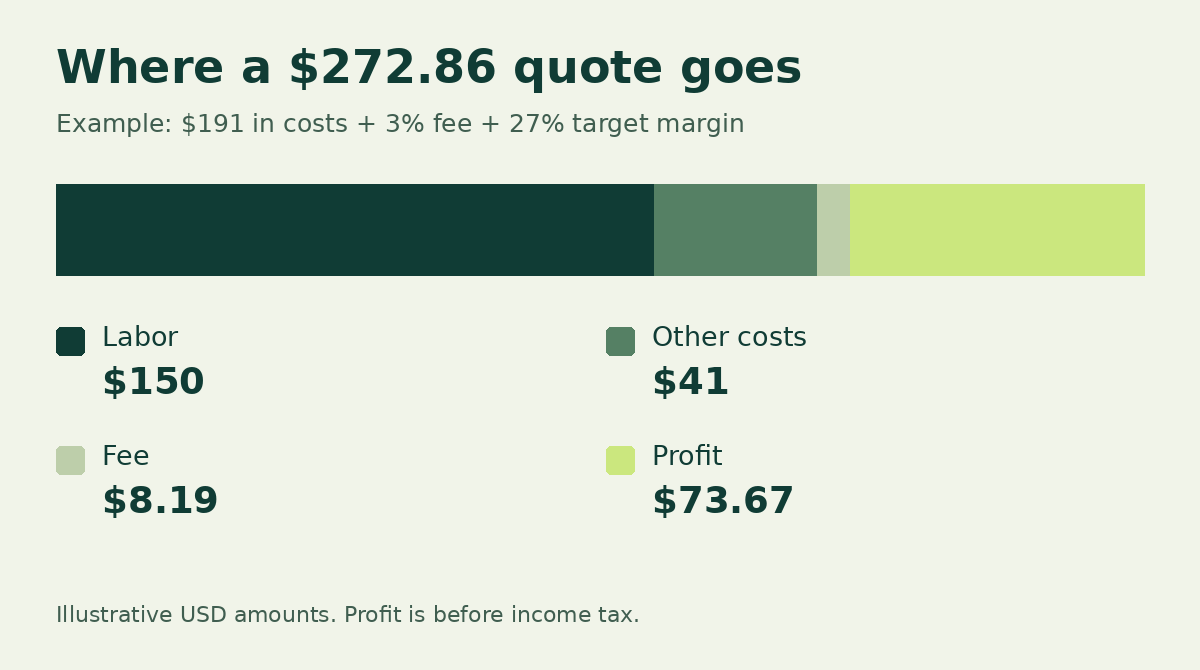
Example: $191 ÷ (1 − 0.03 − 0.27) = $272.86
With a 3% fee and a 27% target margin, 70% of the selling price remains to cover the $191 costs. The target price rounds to $272.86. The fee is about $8.19 and estimated profit is $73.67 before income tax.
The break-even price under the same assumptions is $191 ÷ 0.97, or about $196.91. At a $200 quote, a $6 fee leaves only $3 after those costs. That is a 1.5% estimated margin.
Margin is not the same as markup
If your cost is $140 and you add 30%, you charge $182. The $42 difference is 30% of the cost, but only 23.1% of the selling price. That is before any payment fee.
For a 30% margin with no percentage fee, divide $140 by 0.70 to get $200. With a percentage fee, subtract that rate from the denominator as well. The fee rate and target margin must total less than 100%.
5. Compare the estimate with the completed job
After the clean, record actual labor hours, supplies, extras, and payment fees. If a job expected to use six labor hours repeatedly takes eight, investigate the reason: an incomplete scope, optimistic timing, or an operational problem.
- Was the condition different from what you expected?
- Did the customer request work outside the quote?
- Did access, travel, or setup take longer?
- What needs to change before the next booking?
The calculation gives you a cost-based starting point. Whether a customer accepts the price also depends on the service, scope, and market. If the price does not work, revisit the work and costs before discounting automatically.
Common cleaning-pricing questions
Should I charge by the hour or a flat rate?
Either approach needs a sound estimate of time and costs. A flat rate gives the customer a clear total for an agreed scope; you carry the risk if it takes longer. An hourly price still needs to cover costs beyond wages. Make the scope and billing terms clear.
Can I price cleaning by square footage alone?
Square footage can help compare similar jobs, but it does not describe property condition, task detail, or service frequency. Estimate the work first, then use the per-square-foot figure as a comparison.
What profit margin should I choose?
There is no single target established by this example. Choose a planning goal using your costs and business needs, then test whether the required price fits the work and customers. A calculator estimates a result; it cannot guarantee that result.
Check one real quote today
Use a recently completed job so you can enter actual hours and costs. The free calculator shows estimated profit, break-even price, and a target price without requiring an email address.
Want a reference to keep? Download the free Cleaning Business Pricing Guide (PDF).