The customer paid the agreed price. The team finished the clean. But the job took longer than you planned, and less money was left over.
A short after-job review can show where the estimate missed the work. Start with one completed job, the original quote, and the hours each person actually worked. You do not need a complicated dashboard.
The example below uses illustrative USD amounts, not suggested wages, local market prices, or a recommended margin. Profit means the amount left after the costs included here, before income tax.
1. Compare labor hours, not just time on the clock
Two cleaners working three hours each use six labor hours. If both stay another half hour, the job uses seven labor hours. The extra half hour on the clock adds one full labor hour across the team.
When people work different lengths of time, add their hours individually. One person working four hours and another working three still totals seven labor hours.
Use the same boundaries for the estimate and the review. Record paid setup, travel, or other job-related time in the appropriate cost category, and avoid counting it again elsewhere. Include a fair cost for your own cleaning time if you work on the job.
Overrun percentage = difference ÷ estimated hours × 100
Going from six to seven labor hours is an increase of one hour: 1 ÷ 6 × 100 = 16.7%, rounded. The hours tell you how far the job moved from the plan. The next step shows the dollar effect.
2. See how one extra labor hour changes profit
Suppose you quoted a fixed $250 for the agreed work. You planned six labor hours at $22 per hour, plus an illustrative 15% payroll burden. Supplies, travel, and allocated overhead total $40. The payment fee is 3% of the selling price, with no fixed fee in this example.
For this comparison, the price, wage, payroll-burden rate, and other costs stay the same. Only labor hours change. In a real review, update any other costs that changed too.
| Item | Planned | Actual |
|---|---|---|
| Total labor hours | 6 | 7 |
| Wages at $22/hour | $132.00 | $154.00 |
| Payroll burden at 15% | $19.80 | $23.10 |
| Supplies, travel & overhead | $40.00 | $40.00 |
| Payment fee at 3% | $7.50 | $7.50 |
| Total included costs | $199.30 | $224.60 |
| Profit before income tax | $50.70 | $25.40 |
| Profit as a share of price | 20.3% | 10.2% |
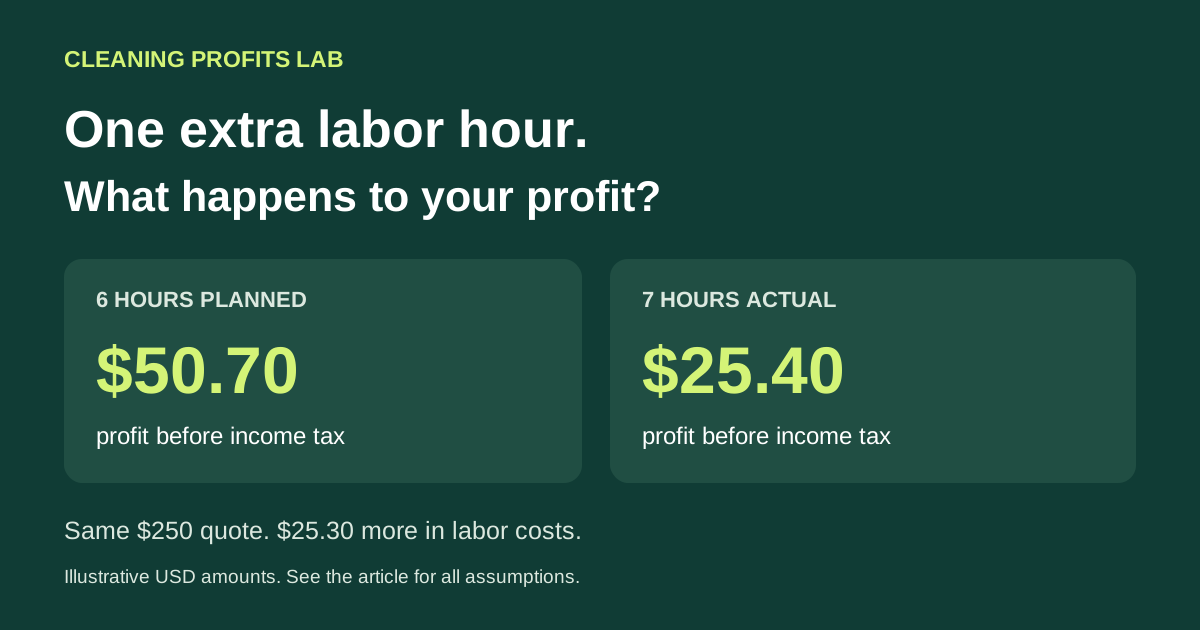
That extra labor hour costs $22 × 1.15 = $25.30. With the quote unchanged, profit falls by the same $25.30, nearly half of the planned $50.70. The payment fee stays $7.50 because the customer’s price did not change.
This is why a small time difference deserves a review even when the customer is happy. It also shows why revenue alone is a poor measure of how the job performed.
3. Find the reason before choosing a fix
Write down what happened while the details are fresh. Ask the team what added work or waiting time. A time variance is a question to investigate, not proof that someone worked too slowly.
- Different property condition: Was there more buildup, clutter, or pet hair than the estimate allowed for?
- Unclear scope: Were tasks such as inside cabinets or an oven treated as included without being counted?
- Customer-requested extras: Was additional work approved, documented, and priced before it was done?
- Access or setup delays: Did keys, parking, entry instructions, or moving supplies take longer?
- Rework or equipment trouble: Was time spent correcting a missed task or replacing a tool?
- A first-visit learning curve: Was the estimate based on an established recurring clean?
The next action should match the cause. Clearer entry instructions may solve an access delay. A better task checklist may reduce rework. Repeated extra work may call for a revised scope and a new price agreed with the customer before the next visit.
4. Turn the review into a better next estimate
Keep a simple record for each completed job:
- Service type, visit date, and agreed scope
- Estimated and actual labor hours, with time by person
- Actual wages or owner-labor allowance and payroll costs
- Supplies, travel, allocated overhead, and payment fees
- The reason for any difference and one change to test
Compare similar visits. Separate an initial deep clean from a maintenance visit, and flag unusual conditions. One difficult job should not automatically reset every estimate. If comparable visits repeatedly take seven labor hours, though, another six-hour estimate needs a clear reason.
Recalculate the next job using realistic hours and complete costs. If the required price is difficult for the customer, discuss a clearly defined smaller scope or a different service arrangement. Do not assume that the same work can simply be done faster.
For the full quote-building process, read How to Price Cleaning Services Without Guessing.
Common questions about cleaning-hour estimates
How often should I review actual hours?
Record hours after each job while they are easy to confirm. A weekly review is a practical starting point for spotting repeat overruns. Give new properties or recently changed scopes closer attention until you understand the work.
Does a time overrun always mean I should raise the price?
No. Check the reason and the complete job result first. An access problem, equipment issue, or one-time extra may need a different response. A repeated gap between the agreed scope and the estimate is a reason to revisit future pricing or scope.
What if cleaners have different hourly wages?
Calculate each person’s hours × wage separately, then add the results. For a calculator with one wage field, divide the total wages by total labor hours to get the job’s weighted average hourly wage. Use a payroll-burden assumption that reflects your records rather than a generic percentage.
Check one completed job today
Open the free calculator and enter the original quote with the estimated hours and costs. Note the result, then replace the estimated labor hours with the actual total and update other costs as needed.
To reproduce this example, use a $250 quote, $22 wage, 15% payroll burden, $12 supplies, $8 travel, $20 overhead, a 3% payment fee, and a $0 fixed fee. Compare six labor hours with seven. Your chosen target margin affects the target price, not the profit at the fixed $250 quote.
Review your cleaning job’s profit →
No email is required. Use your own numbers for a real decision, and keep a record of the result before closing the page.